

Welcome to the Partisan Advertising blog.
The Partisan Advertising blog has advertising agency-related posts dating back to 2010 covering a vast array of topics.

Four simple steps to end your year with a bang
We’ve passed the halfway mark in 2013 and many of you might already be looking for ways to elevate your sales for the rest of the year and even for 2014.
With that in mind here are four simple marketing approaches that will help you.
1. Be honest with your customers.

People don’t do business with businesses; we do business with people. If you talked to people the way advertising talked to people, they’d punch you in the face. Our brains cannot relate to the over-perfected, over-Photoshopped advertising messages we see every day, so we are simply ignoring or deriding them. How many adverts have you seen that portray an ideal family environment that just doesn’t exist or match anything you’ve seen in your life? When was the last time you had a burger that actually looked like the burger you saw in the advert? How many ads have you approved that portray consumers using your products like they’ve just discovered a pot of gold at the end of the rainbow? No one acts and behaves like that in the real world and the sooner you recognise and understand this the better. Start to care. That simple word sums up so much. Have you ever been to a restaurant or a hospital where they genuinely care? You can tell, immediately. So can your customers.
2. Satisfy your customer’s wants.
We no longer buy products because we need them; we buy them because we want them. This is true because almost everything we can realistically imagine that we need has already been invented. There used to be a time when we had fewer choices but now we have an infinite supply. This wasn’t true just 20 years ago when we had a lot more time and a lot less choices. Our disposable income had far fewer ways to get squandered, so if a company came up with something really cool, like the mobile phone, we’d find a way to pay for it. But the game has changed and now we’re only interested in satisfying our wants so please start satisfying our wants.
3. You can’t be everywhere.
Start prioritising where you want to interact with your clients. When it comes to advertising, the media landscape is just too vast to reach everyone. Simply put, there are so many media alternatives that consumers can no longer be effectively reached by mass media such as television or radio. At the end of the day, every business has a financial target to reach and it doesn’t matter whether it takes 5000 or 100 customers to reach that goal, so why chase everyone? A woodpecker can peck once on every tree in a forest in the hopes that he’ll find what he’s looking for or he can concentrate his efforts on a smaller number of trees and get results.
4. Leave the centre of the market and aim for the edges.
Every market has two parts: there’s the big, fat juicy centre and then there are the edges. For obvious reasons the centre appeals to more of us than it should (must be the Lizard-Brain at work) but it’s not a safe place because nothing remarkable ever takes place there. If we take a look at the music industry and compare Lady Gaga to Britney Spears it’s easy to see where their position in the market lies. When Britney decided to go to the edges a few years back she reworked her image, forgot her underwear and tried to reinvent herself but her audience rejected her, forcing her brand further back into the centre than it had ever been before. Lady Gaga on the other hand, started at the edge and the centre moved towards her. Now she can wear dresses made out of meat or ride a panda to the next Grammy Awards and it will all fit perfectly within the scope of her brand and (even better) people will accept it. The edge isn’t for everyone, but would you really want to market yourself as “more bland than the leading brand”?
Who’d want to work in Hell(ers)?
I stumbled upon this marketing image on facebook a few weeks ago.

What the Hellers is going on with the expiry date?
I assume it was created by the company’s Human Resources department. HR departments the world over are always super keen to dot the i's and cross the t's and make sure everyone knows where the lines are in Corporate Land. I wonder if the Marketing Department had any say in it? I assume so. Someone had to design it and lay it out in the correct corporate font and make sure it was framed in the correct colour.
The reality however is that from an internal marketing point of view this is a complete cock up. Who’d want to work in an environment where the company has to so blatantly state the obvious about what you should and shouldn’t be doing? I know that it’s fairly uncommon to see the human race using common sense but do Hellers really have to tell their staff not to be bullies and that they shouldn’t swear at people? And should this really have an expiry date? We’re talking about people here, not sausages!
Someone in a leadership position had to have authorized this when they should really have rejected it. There’s no way that this kind of corporate mantra will ever attract and keep top-quality staff. Could you imagine this sign at Google, Apple or Virgin? All Hellers are going to get here are Sheepwalkers. But I suppose that’s OK since all they manufacture is processed meats, and really, how much innovation can there be in that field?
Quite a lot I’d say. Consider that Todd Heller opened the first Hellers butchery in Christchurch in 1985 and in less than 28 years has grown the business to become New Zealand’s largest smallgoods manufacturer. You don’t get growth like that without innovation, especially from a marketing perspective. But now that they’re at the top I suspect they’re resting on their laurels a bit. Who could (and who’d want to) try and claim their throne?
As consumers, we never get to see behind the doors of big businesses like Hellers. We don’t know what happens in their boardrooms or what goes on at the production line. All we see is what they want us to see. The problem with that is it’s 2013 and far too often consumers get to peek behind the curtain and see what’s really going on.
The death of advertising and interruption marketing
Interruption marketing is what all advertising is: something that interrupts whatever you’re doing in the hope to steal your attention.
The interruptions have become more overt, extravagant and unbelievable, all in an effort to gain more of our attention.
The reality is that before this decade is up, this form of interruption marketing will be dead. Marketing will become personalised, customised and adapted to what we, the consumers, want, simply because we will be choosing what content/programming we want to watch. This essentially means that advertising will have to become content and not an interruption and the only way brands will get to show us their content is if they have our permission.
How do I know this? Because it’s already happening.
Television used to be our biggest influencer but for years we’ve had devices that have allowed us to record what we want and skip adverts.
The amount of money spent on mobile and online advertising has increased dramatically whilst traditional media spend has declined or experienced smaller growth.
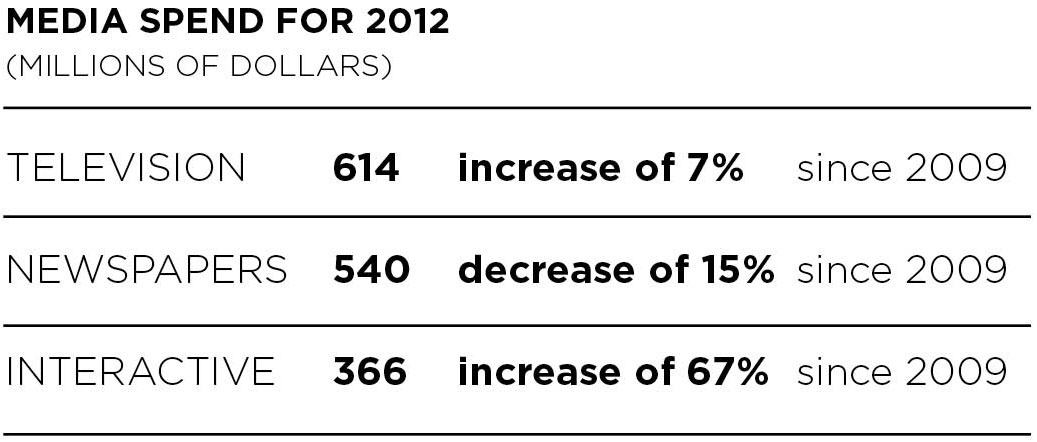
In the last week, SKY TV lost its multi-million dollar coverage of the English Premier League to an online broadcaster. The relevance of SKY's loss is simple: it shows that choosing content is starting to become important to viewers. SKY said the loss wasn't the end of the world for them, but in reality, it's the beginning of the end. They desperately need to reassess their business model if they want to keep their subscribers. Well done to Coliseum Sports Media for this fantastic coup. And just imagine what will happen when they win the rights to the All Black's games or the World Cup in 2014...
Thanks to the dramatic growth of the mobile market we’re starting to “multi-screen” our TV time. We’re no longer couch potatoes and we’re actually becoming more involved in selecting the programming we want to watch, and then seeking out information about the shows or commenting about them on social networks.

Our Multi-Screening Habits
The Matrix, I mean Google and especially Google Plus, is the biggest influencer of what we see online. Google monitors everything we do online and displays what it thinks we want to see based on our online history. The question is: when will Google start displaying what it thinks we want to see everywhere else? The tech is already here but the link hasn’t been made just yet.
Almost every new television has Internet connectivity as standard. It will only be a matter of time when we’ll be creating specific user accounts for our televisions, most likely through Google, which in turn will allow us to customise what we want to watch. And this will include what advertising we want to see.
If I make a search online for BMW, Google displays some links and related ads. Wouldn’t it make sense for Google to share this info with my other devices? Instead of then seeing a series of random 30-second ads during a commercial break, I could now watch a 3-minute commercial for BMW? And by commercial, I mean content.
I’ve used BMW as an example because BMW was already doing this way back in 2001. They got a group of leading filmmakers and actors to create and star in a series of short movies based on BMW’s cars. And guess what? It worked brilliantly because it wasn’t advertising – it was content. You can view one of my favourites directed by Guy Ritchie at the end of this post.
In 2001, BMW's sales increased by 12.5%, and by 17.2% in 2002. No new product launches - just a series of movies.
So how do we, as advertisers, marketers and business owners, get ready for what’s coming?
The first step is to stop interrupting and focus on getting permission to communicate with your customers.
The future of permission marketing lies with mobile… but not mobile advertising. At the moment all mobile does is interrupt us. Take a look at these screen grabs. Why do I get these ads? I'm married, own an iPhone and WTF is the last ad on the right for? Pointless.

The real marketing benefits of mobile can be found in the apps we use.
Here are five reasons why:
1. Apps aren’t advertising
2. We choose them
3. We value them for their functionality
4. We don’t find them interruptive.
5. We spend on average 82% of our mobile time with them.
So if apps are the beginning of the end of interruption marketing, how are you going to use an app as a marketing tool and what should you bear in mind to make it a success?
1. The app must add value to your customers’ lives. How do people buy and use your product? Find a way in which your app can add value to their interaction.
2. Make it convenient to use. Remember the customer’s favourite person: ME.
3. Make it social. Activities that enhance connections among friends, like apps, will enhance the user experience of connecting with friends.
4. Entertain us. 40% of our app time is spent on games.
With more than 275,000 developers registered to build apps just for Apple’s iTunes store, the problem isn’t how to make an app, but what to say and do that will start a long-lasting, permission-based relationship with your customers.
And the simplest answer is to treat your customers like you would like to be treated yourself. That’s the essence of permission marketing.
What Marketers Can Learn From Calendar Girls
Would you be able to create great advertising for Calendar Girls, an upmarket strip club? Highly doubtful. The truth is that Calendar Girls has some unique creative challenges that most advertising folk would struggle with. The first one: they can't advertise.
In the traditional world of advertising, there are three types of clients:
1. those with vast sums of money to spend;
2. those who offer great creative opportunities;
3. and then there’s everyone else.
At first, I thought that a company like Calendar Girls (a high-class strip tease venue in case you didn’t know) fell into the second category. How wrong I was. The truth is that Calendar Girls has some unique creative challenges that most marketers would struggle with.
I recently met with Jacqui Le Prou, the Director of Calendar Girls, and asked her a few questions about how the brand is growing and how her distinctive approach to marketing has helped to fuel this growth. I wanted to know how she copes with the obstacles that her brand encounters every day and still comes out smiling.
Let’s start with the fact that Calendar Girls can’t show their product in any of their advertising. You won’t see any gargantuan billboards on the motorway or full-page ads in the Herald showing off semi-naked, beautiful women, wearing sexy, seductive lingerie because it just wouldn’t be tolerated. Strange then that a lingerie brand like Bendon, which is also built around sex, seduction and power, does exactly that and gets away with it.
Take a look at this borderline pornographic ad for Bendon’s Elle Macpherson Intimates range:

Calendar Girls would never (ever) get away with showing anything as revealing and risqué as this in any mainstream publication. And if they did, the village idiots would be marching down K-Road, flaming torches and pitchforks in hand, chanting “Who’s gonna save the children? We are!”
And then there’s the intense scrutiny Calendar Girls is always under. New Zealand’s many media watchdogs always closely inspect Calendar Girls’ advertising, and there’s just no chance that they’d be able to get away with anything remotely controversial. Which doesn’t make much sense given that Calendar Girls is already seen by many as being controversial. So while companies like Hell, Tui and Libra can actively court controversy for the financial benefit of their brand, Calendar Girls can’t.

So how do you market and advertise a company like Calendar Girls when you’re so restricted that you can’t even show your product? And more importantly, what can we learn from what they do?
It boils down to the simplest of things: the customer experience.
When I interviewed Jacqui Le Prou, she was adamant that the experience was everything. She went on to say: “I want to give my customers the best possible experience they can ever have. If they come to Calendar Girls and have a terrible experience, they tell everyone they know, yet if the customer has an amazing experience he might only tell a handful of people.” Jacqui knows that word of mouth is vital for the success of her business and that it starts with the experience her customers have.
Now let’s leave the strip tease world for a moment and look at the customer experience in another environment, such as the hardware industry. I think we can all agree that the hardware industry offers an awful experience at best. From the infinite amount of parity products to the endless miles of maze-like aisles, coupled with the underpaid and unmotivated staff, the in-store experience in the hardware industry is totally unsatisfying. The vast acres that places like Bunnings and Mitre 10 occupy are as bland as the dark side of the moon, and the only time customers ever have a great experience there is when they leave. Yet these companies spend millions of dollars on advertising every year to get customers into their stores, just so they give them a below-average experience. In fact, Mitre 10 and Bunnings spent over $65 million dollars combined on advertising in 2012. Did this immense amount of money change their customer’s in-store experience? Not in the slightest.
Back at Calendar Girls, Jacqui Le Prou knows that no amount of money spent on advertising will change how people perceive her business. As she puts it: “the stereotype is there and people will think what they want to think and no amount of money can change that.”
For Calendar Girls, and so many other businesses in New Zealand, it will always boil down to the customer experience, and that’s awesome news for marketers who want to change the status quo! Almost everything in the retail environment can be controlled and manipulated to make the customer experience something worth talking about, and this makes it an essential marketing tool. I’m not just talking about the in-store experience either – the way customers experience your products and your brand after the purchase is just as important, if not more so.
Keep this in mind and always consider that in our connected world, one person’s bad experience can become everyone’s bad experience, but a good experience can create someone who actively promotes your brand: an evangelist. What’s that worth to you?