
Some advertising campaigns make you stop and think.
Then there are campaigns that make you stop and think, “Why?”
And then there are campaigns that give you motion sickness.
Sealord’s new Skipper pet-food campaign, Feed Them Beautiful, is one of them.
The idea is apparently to treat pet food like a luxury beauty product. Shiny fur. Clear eyes. Strong nails. Healthy skin. The campaign borrows heavily from the visual language of beauty advertising, with glossy imagery, editorial-style photography and, yes, semi-naked human bodies.
It's certainly different. But different isn't necessarily good.
Why are we looking at naked people?
Let's start with the obvious question.
Why are there semi-naked people in an advert for pet food?
The thinking seems to be that Skipper contains omega-3 and marine collagen, and that these ingredients contribute to the visible signs of a healthy pet. So the campaign has borrowed the visual conventions of beauty and skincare advertising.
Fair enough.
But there's a difference between using the codes of a category and simply reproducing its most obvious clichés.
Beauty advertising has spent decades telling us that beautiful bodies, flawless skin and carefully lit people equal desirable products.
So perhaps the creative idea was: let's make pet food look like a beauty product.
The problem is that the joke arrives before the advertising message does.
You see the beautiful people.
You see the beautiful photography.
You see the beautiful styling.
And eventually you discover that you're looking at pet food.
The question is whether the creative device makes you more interested in Skipper, or whether you're simply admiring the production.
When the execution becomes the idea.
There's nothing inherently wrong with making pet food advertising beautiful.
In fact, there's plenty to like about the ambition.
Skipper is entering a category where many brands communicate in broadly similar ways: happy dogs, happy cats, bowls of food, healthy-looking animals and earnest claims about nutrition.
So trying to disrupt that category is entirely reasonable.
Sealord itself says the intention was to take a fresh approach, challenge pet-food conventions and have some fun.
But here's where I think the campaign falls down.
It feels like the advertising is more interested in being advertising than selling the product.
The campaign looks like a parody of a beauty campaign.
And once you've recognised the parody, what have you learned about Skipper?
That it's fish-based?
That it contains omega-3?
That it contains marine collagen?
That it might make your pet look healthier?
Those are potentially useful reasons to buy the product.
Yet they seem to be playing second fiddle to the creative conceit.
And then there's the food itself.
Here's another question I'd ask if I were reviewing this campaign from the perspective of a pet owner:
Where is the appetite appeal?
Pet food isn't perfume.
It's pet food.
And yet the campaign seems determined to make the product look like something you'd find on a bathroom shelf rather than something you'd put in your pet's bowl.
The irony is that the campaign is selling the result of feeding the product rather than making us interested in the product itself.
That's a risky strategy.
Because if the actual food looks like the same brownish, processed mash that occupies much of the pet-food aisle, then telling me it's "beautiful" doesn't necessarily make me believe it.
Calling something beautiful doesn't make it beautiful.
And calling pet food a beauty product doesn't make it one.
Is this really differentiation?
This is the part that interests me most as an advertising person.
The stated ambition is to challenge category conventions.
But has it really done that?
Or has it simply taken a familiar advertising convention from one category and transplanted it into another?
We've seen this trick before.
Take the visual language of luxury fashion.
Apply it to something ordinary.
Make it self-aware.
Add a little irony.
Call it disruptive.
It can work brilliantly.
But it can also become advertising's version of wearing sunglasses indoors: something that looks cool in the creative department but leaves everyone else wondering what the hell is going on.
Clever isn't the same as effective.
I have no doubt that considerable thought has gone into Feed Them Beautiful.
And technically, it appears to be very well executed.
The photography is polished. The production values are high. The campaign is visually distinctive. And the beauty-editorial treatment certainly makes it stand out from traditional pet-food advertising.
But advertising isn't an art competition.
The question isn't:
“Is this clever?”
The question is:
“Will this make people want to buy Skipper?”
Those are two very different questions.
A campaign can win awards, generate industry discussion and make creatives congratulate each other over coffee and still fail to build a meaningful brand.
Perhaps we're overcomplicating pet food?
There is something wonderfully simple about the underlying product story.
Sealord has developed a seafood-only pet food using unused fish product and waste, turning material that might otherwise be discarded into nutritionally complete pet food. The product is also naturally rich in omega-3 and marine collagen.
That's actually interesting.
There is a sustainability story.
There is a nutritional story.
There is a distinctly Sealord story.
There is a reason for a seafood company to enter the pet food aisle.
And there is a potentially compelling reason for a pet owner to choose the product.
So why bury all of that underneath a campaign about beautiful people?
The irony of “Feed Them Beautiful”
Perhaps the greatest irony is that the campaign seems to be telling us not to judge the product by its appearance.
Instead, we're supposed to judge it by the appearance of the pet eating it.
That's a clever thought.
But clever thoughts don't automatically make great advertising.
Sometimes the strongest creative idea is the one that makes the product impossible to misunderstand.
I'd have liked to see Skipper own what makes it genuinely different.
Fish.
Nutrition.
Omega-3.
Marine collagen.
Using more of the fish resource rather than wasting it.
Those are real stories.
Instead, we're given a beauty campaign where the product itself almost feels like the supporting actor.
So, is Feed Them Beautiful a bad campaign?
Not necessarily.
It's certainly memorable.
It's certainly different.
And if the objective was to get people talking about a new pet-food brand, it has probably succeeded.
But that's a pretty low bar for advertising.
The real test is whether people remember, and buy (most importantly), Skipper, or whether they simply remember that weird pet-food ad with all the beautiful, semi-naked people.
Because there's a big difference between being remembered and being remembered for something useful.
And that's the lesson I'd take from Feed Them Beautiful.
Don't confuse attention with persuasion.
Don't confuse beautiful advertising with effective advertising.
And, above all, don't assume that because you've made something look different, you've actually made the brand different.
Sometimes the best advertising isn't the campaign that makes the biggest splash.
It's the campaign that gives people a really good reason to buy.
And frankly, I'd rather be sold something genuinely compelling than be told that a bowl of brown fish mash is beautiful.
Lastly, why isn’t the Feed Them Beautiful visual campaign being repeated on the Skipper website?
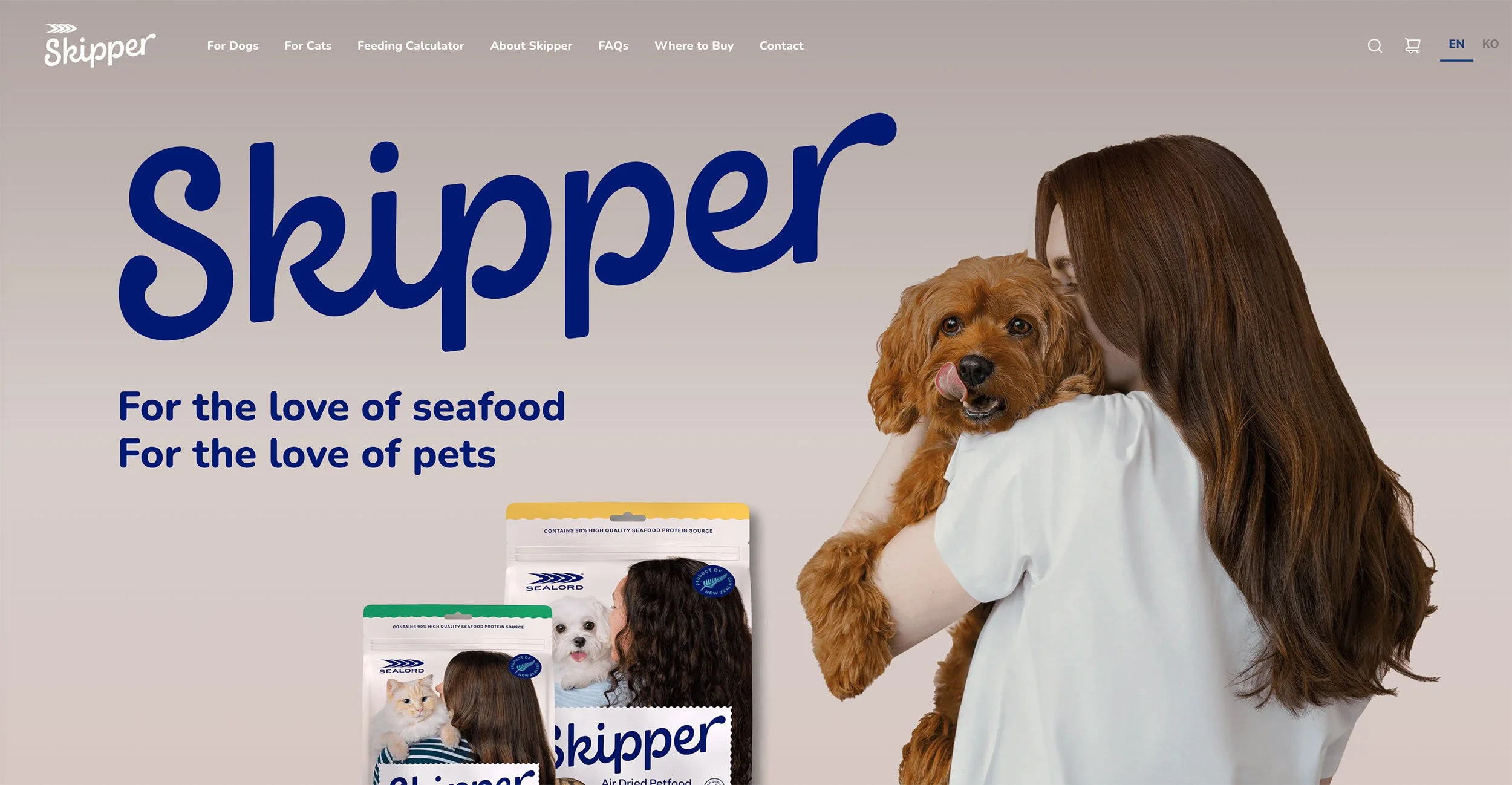
Where’s the campaign follow-through? No semi-naked people here. Maybe it’s because Sealord’s Korean customers would just not get it?