
Welcome to the Partisan Advertising blog.
The Partisan Advertising blog has advertising agency-related posts dating back to 2010 covering a vast array of topics.
16 Years of Partisan.
Today, Partisan Advertising turns 16.
Sixteen years.
When we started Partisan back in 2010, I don't think we could have imagined quite where the next 16 years would take us. There was no grand five-year plan. No enormous office. No army of account managers. Just a belief that there was another way of running an advertising agency. One where the people who won the business were the same people who did the work. One where clients could actually talk to the people doing the thinking.
And, most importantly, one where good ideas weren't just about making something look good. They had to make a difference.
Sixteen years later, that philosophy is still at the heart of Partisan.
Over 16 years, a lot of people have passed through Partisan. Some stayed for years. Others stayed for shorter periods. Some were employees, some freelancers, some contractors, and some became part of the extended Partisan family.
And every one of them left something behind.
Kei Serrano was an important part of the team during a period when social media and digital marketing were becoming increasingly important to our clients. Kei worked across projects including TR Group, PBT, Botany Town Centre, Auckland Eye and TERRA, as well as contributing her own thinking to the Partisan blog.
Soo Park was another important member of the team, working across some of our biggest accounts, including TR Group, PBT and Botany Town Centre.
Pamela Du Toit and Mike Isle also played significant roles across some of the agency's major projects.
And, of course, there was Ash, who has been there from the beginning.
The thing about working in a small agency is that everybody leaves their fingerprints on the work. Ideas get challenged. Arguments get had. Someone comes up with something at 4.30 on a Friday afternoon that turns out to be the best idea of the week. Someone else looks at it and says, "No way." And occasionally, the "no way" turns into the campaign. That's advertising.
Over the years we've had the privilege of working with some extraordinary businesses.
TR Group. PBT. Bridgestone. CRC. AMP Capital. Elanco. LG Electronics. Voyager. Renault. Botany Town Centre. Auckland Eye. Virbac Animal Health. Excellence Pet Food. TERRA.
And many others. Some relationships lasted for years. Some started with a single advertisement. Some began with a problem that seemed almost impossible to solve. And some grew into partnerships where we became involved in almost every aspect of how the brand communicated.
TR Group is a good example.
We started working with them in 2014, when they had grown substantially but had never really had a formal marketing strategy. Over the following years, we worked across strategy, branding, advertising, television, digital, social, media, signage and marketing — even helping launch TR Group Australia after the company's acquisition of Semi Skel Hire.
The work generated a 150% increase in lease sales in 12 months.
But the number isn't really what I remember most. I remember getting to know the business. Understanding what made it different. Finding the idea that could express that difference. And then watching that idea become part of the business itself.
That's the bit that makes advertising worthwhile.
One of the things we've learned over the years is that you don't necessarily need a huge budget to make an impact. You need a good idea. For Virbac Animal Health, we were launching PenClox 1200 into a competitive agricultural market where much of the advertising looked remarkably similar. So rather than doing what everyone else was doing, we looked for a different way in. The product went on to sell 406% over forecast in less than two months.
With Excellence Pet Food, the challenge was different again. The product was excellent. The challenge was getting consumers to think differently about where they bought their pet food. The resulting campaign helped deliver a 21% increase in sales in just two months.
These are the sorts of results that remind us why we do this. Creativity isn't decoration. It should have a job to do.
Then there were the big ones
Some projects were simply enormous.
Our work with Botany Town Centre involved more than 90 projects over two years.
Fashion shows.
Christmas.
Chinese New Year.
School holidays.
Community events.
Digital campaigns.
Photography.
Video.
Advertising.
And a major redevelopment.
It was the sort of account where there was always something happening.
And that's another thing we've loved about Partisan.
The variety.
One day we're thinking about heavy trucks. The next we're selling pet food. Then we're launching a television. Then we're working on healthcare. Then we're trying to explain something incredibly complicated in a way that somebody will understand in three seconds. It's impossible to get bored.
When Partisan started on October 1st 2010, the advertising industry looked very different.
Facebook was still relatively new.
Instagram didn't exist; it only launched on the 6th of October that same year. TikTok certainly wasn't a thing. Digital advertising was growing rapidly, but traditional media still dominated much of the conversation. Since then we've watched the industry transform. We've moved from print and television to social, search, digital, mobile, content, data and now artificial intelligence. We've designed websites, built brands, created campaigns, produced videos, managed media, written social posts and worked on just about every type of communication you can imagine. But while the tools have changed, something hasn't.
People still respond to ideas.
They still notice what's different. They still remember things that make them laugh, think or feel something. And businesses still need communication that delivers results.
Have we got everything right?
Absolutely not. We've made mistakes. We've backed ideas that didn't work. We've underestimated things. We've probably overcomplicated things occasionally. We've learnt that clients don't always want what you think they want. And we've learnt that sometimes the best thing an agency can do is listen.
But we've also learnt that running a small agency gives you something pretty special. You get to know your clients. You get to understand their businesses. You get to see the results of your work. And you get to build relationships that go well beyond a campaign.
So, 16 years on...
Looking back, I'm incredibly proud of what Partisan has become.
Not because we've worked with a particular list of brands.
Not because we've produced a particular number of campaigns.
Not because we completed over 3,000 jobs for TR Group.
And not because everything we've done has been perfect.
I'm proud because we're still here.
Still independent.
Still small.
Still hands-on.
Still arguing about ideas.
Still trying to find the thing that makes a business different.
And still trying to turn that difference into something people will notice.
Most of all, I'm grateful.
To the people who have worked here. To the freelancers, suppliers and production people who've helped bring ideas to life. To the clients who've trusted us with their businesses. To the people who've challenged us. To the people who've encouraged us. And to everyone who has contributed, in big ways or small, to the Partisan story.
Because ultimately, Partisan isn't a building, a logo or a website.
It's the people. It's the relationships. It's the ideas. It's the work. And it's everything that happens between those things.
Sixteen years ago, Partisan started with an idea.
Sixteen years later, we're still chasing them.
Happy 16th birthday, Partisan.
Here's to the next idea.
Feed Them Beautiful? Or Feed Them Something Better?
Some advertising campaigns make you stop and think.
Then there are campaigns that make you stop and think, “Why?”
And then there are campaigns that give you motion sickness.
Sealord’s new Skipper pet-food campaign, Feed Them Beautiful, is one of them.
The idea is apparently to treat pet food like a luxury beauty product. Shiny fur. Clear eyes. Strong nails. Healthy skin. The campaign borrows heavily from the visual language of beauty advertising, with glossy imagery, editorial-style photography and, yes, semi-naked human bodies.
It's certainly different. But different isn't necessarily good.
Why are we looking at naked people?
Let's start with the obvious question.
Why are there semi-naked people in an advert for pet food?
The thinking seems to be that Skipper contains omega-3 and marine collagen, and that these ingredients contribute to the visible signs of a healthy pet. So the campaign has borrowed the visual conventions of beauty and skincare advertising.
Fair enough.
But there's a difference between using the codes of a category and simply reproducing its most obvious clichés.
Beauty advertising has spent decades telling us that beautiful bodies, flawless skin and carefully lit people equal desirable products.
So perhaps the creative idea was: let's make pet food look like a beauty product.
The problem is that the joke arrives before the advertising message does.
You see the beautiful people.
You see the beautiful photography.
You see the beautiful styling.
And eventually you discover that you're looking at pet food.
The question is whether the creative device makes you more interested in Skipper, or whether you're simply admiring the production.
When the execution becomes the idea.
There's nothing inherently wrong with making pet food advertising beautiful.
In fact, there's plenty to like about the ambition.
Skipper is entering a category where many brands communicate in broadly similar ways: happy dogs, happy cats, bowls of food, healthy-looking animals and earnest claims about nutrition.
So trying to disrupt that category is entirely reasonable.
Sealord itself says the intention was to take a fresh approach, challenge pet-food conventions and have some fun.
But here's where I think the campaign falls down.
It feels like the advertising is more interested in being advertising than selling the product.
The campaign looks like a parody of a beauty campaign.
And once you've recognised the parody, what have you learned about Skipper?
That it's fish-based?
That it contains omega-3?
That it contains marine collagen?
That it might make your pet look healthier?
Those are potentially useful reasons to buy the product.
Yet they seem to be playing second fiddle to the creative conceit.
And then there's the food itself.
Here's another question I'd ask if I were reviewing this campaign from the perspective of a pet owner:
Where is the appetite appeal?
Pet food isn't perfume.
It's pet food.
And yet the campaign seems determined to make the product look like something you'd find on a bathroom shelf rather than something you'd put in your pet's bowl.
The irony is that the campaign is selling the result of feeding the product rather than making us interested in the product itself.
That's a risky strategy.
Because if the actual food looks like the same brownish, processed mash that occupies much of the pet-food aisle, then telling me it's "beautiful" doesn't necessarily make me believe it.
Calling something beautiful doesn't make it beautiful.
And calling pet food a beauty product doesn't make it one.
Is this really differentiation?
This is the part that interests me most as an advertising person.
The stated ambition is to challenge category conventions.
But has it really done that?
Or has it simply taken a familiar advertising convention from one category and transplanted it into another?
We've seen this trick before.
Take the visual language of luxury fashion.
Apply it to something ordinary.
Make it self-aware.
Add a little irony.
Call it disruptive.
It can work brilliantly.
But it can also become advertising's version of wearing sunglasses indoors: something that looks cool in the creative department but leaves everyone else wondering what the hell is going on.
Clever isn't the same as effective.
I have no doubt that considerable thought has gone into Feed Them Beautiful.
And technically, it appears to be very well executed.
The photography is polished. The production values are high. The campaign is visually distinctive. And the beauty-editorial treatment certainly makes it stand out from traditional pet-food advertising.
But advertising isn't an art competition.
The question isn't:
“Is this clever?”
The question is:
“Will this make people want to buy Skipper?”
Those are two very different questions.
A campaign can win awards, generate industry discussion and make creatives congratulate each other over coffee and still fail to build a meaningful brand.
Perhaps we're overcomplicating pet food?
There is something wonderfully simple about the underlying product story.
Sealord has developed a seafood-only pet food using unused fish product and waste, turning material that might otherwise be discarded into nutritionally complete pet food. The product is also naturally rich in omega-3 and marine collagen.
That's actually interesting.
There is a sustainability story.
There is a nutritional story.
There is a distinctly Sealord story.
There is a reason for a seafood company to enter the pet food aisle.
And there is a potentially compelling reason for a pet owner to choose the product.
So why bury all of that underneath a campaign about beautiful people?
The irony of “Feed Them Beautiful”
Perhaps the greatest irony is that the campaign seems to be telling us not to judge the product by its appearance.
Instead, we're supposed to judge it by the appearance of the pet eating it.
That's a clever thought.
But clever thoughts don't automatically make great advertising.
Sometimes the strongest creative idea is the one that makes the product impossible to misunderstand.
I'd have liked to see Skipper own what makes it genuinely different.
Fish.
Nutrition.
Omega-3.
Marine collagen.
Using more of the fish resource rather than wasting it.
Those are real stories.
Instead, we're given a beauty campaign where the product itself almost feels like the supporting actor.
So, is Feed Them Beautiful a bad campaign?
Not necessarily.
It's certainly memorable.
It's certainly different.
And if the objective was to get people talking about a new pet-food brand, it has probably succeeded.
But that's a pretty low bar for advertising.
The real test is whether people remember, and buy (most importantly), Skipper, or whether they simply remember that weird pet-food ad with all the beautiful, semi-naked people.
Because there's a big difference between being remembered and being remembered for something useful.
And that's the lesson I'd take from Feed Them Beautiful.
Don't confuse attention with persuasion.
Don't confuse beautiful advertising with effective advertising.
And, above all, don't assume that because you've made something look different, you've actually made the brand different.
Sometimes the best advertising isn't the campaign that makes the biggest splash.
It's the campaign that gives people a really good reason to buy.
And frankly, I'd rather be sold something genuinely compelling than be told that a bowl of brown fish mash is beautiful.
Lastly, why isn’t the Feed Them Beautiful visual campaign being repeated on the Skipper website?
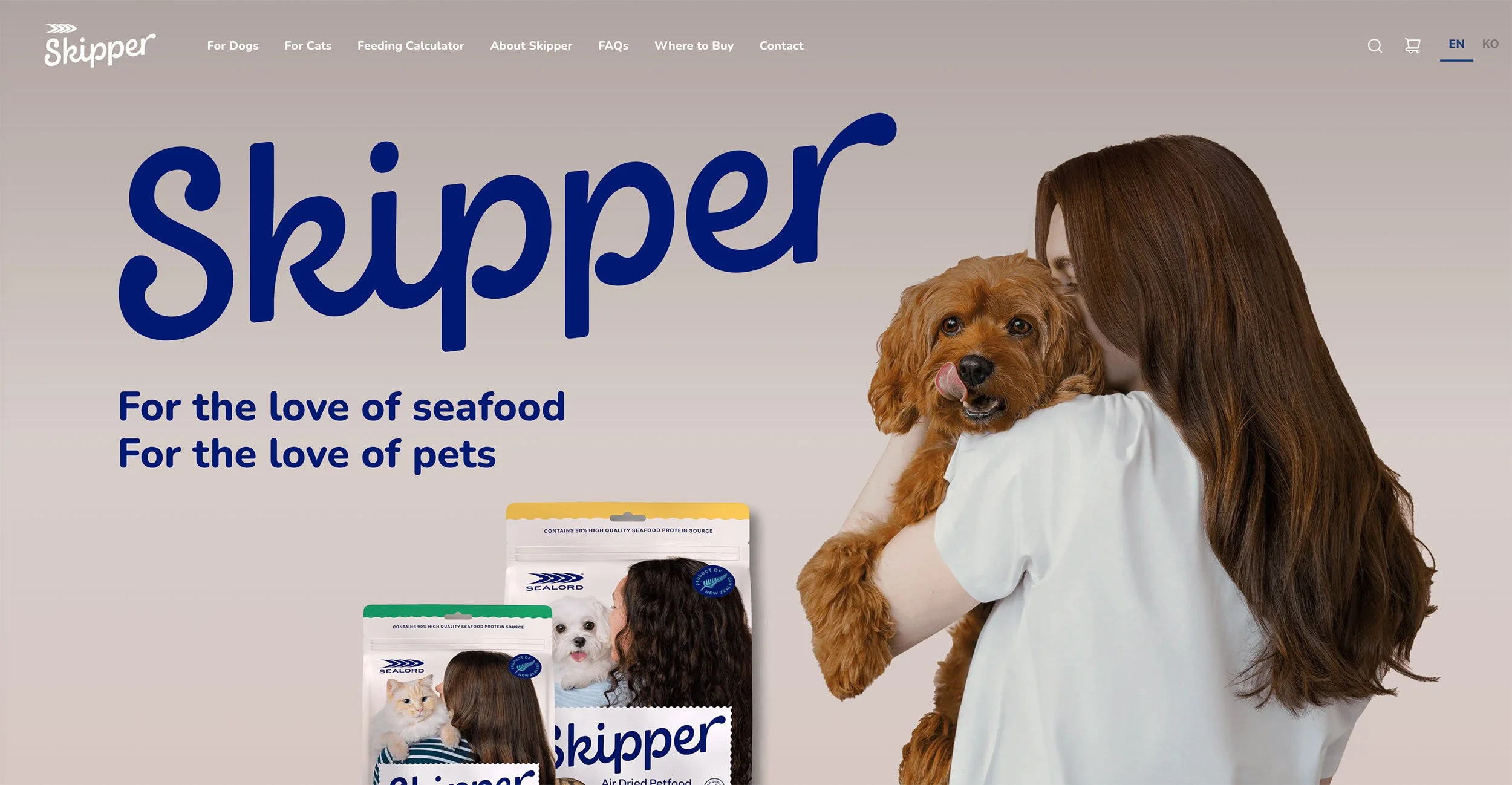
Where’s the campaign follow-through? No semi-naked people here. Maybe it’s because Sealord’s Korean customers would just not get it?
When Advertising Takes Flight
What the Cape Town Stadium Flyover Can Teach Us About Branding.
Sometimes the best advertising isn't an ad.
It isn't a billboard. It isn't a 30-second television commercial. It isn't a sponsored social media post carefully crafted to fit an algorithm.
Sometimes, it's two aeroplanes flying dramatically over a packed stadium.
That was the case in Cape Town this weekend when two Airlink aircraft performed a spectacular flyover of DHL Stadium moments before the Springboks faced the All Blacks in the second Test of the Rugby's Greatest Rivalry series. The aircraft, painted in colours representing the two teams, became part of the pre-match spectacle—and within minutes, footage of the flyover appeared across social media and news platforms worldwide.
From an advertising perspective, it's a fascinating example of how a well-executed brand experience can generate far more attention than conventional advertising.
Make people stop and look.
The first rule of effective advertising is simple: get noticed.
That's becoming increasingly difficult. We're surrounded by thousands of commercial messages every day. Consumers scroll past ads, skip videos, ignore banners and become increasingly good at filtering out anything that looks like advertising.
But it's much harder to ignore two passenger jets roaring over a stadium just before kick-off.
The flyover created an immediate visual spectacle. Tens of thousands of people in the stadium saw it. Millions more saw it on television and online. And because it was unusual and visually dramatic, people didn't simply watch it—they filmed it, photographed it, shared it and talked about it.
That's powerful branding.
Turn an audience into a media channel
One of the cleverest things about experiential advertising is that the audience becomes part of the distribution network.
Everyone with a smartphone suddenly becomes a potential broadcaster.
The Cape Town flyover is a perfect example. Videos from different angles quickly appeared online, sparking conversation and letting the stunt travel well beyond the people physically inside the stadium.
This is where traditional advertising and experiential marketing increasingly overlap.
You don't necessarily need to buy every impression if you can create something people genuinely want to share.
The best campaigns don't just reach an audience.
They give the audience something worth talking about.
Give the brand a role in the story.
Another reason the flyover worked so well is that Airlink wasn't simply placing its logo next to a sporting event.
The brand was actually part of the experience.
Airlink was the official domestic airline for the Rugby's Greatest Rivalry tour, transporting the teams, coaches and support staff between matches. The aircraft therefore weren't an unrelated advertising stunt—they were directly connected to the event's story.
That's an important distinction.
Good sponsorship isn't just about putting a logo on something.
It's about finding a credible reason for the brand to be there.
An airline has aeroplanes. Rugby has teams travelling between cities. Put the two together and suddenly the brand has a natural role within the story.
That's much more powerful than simply sticking a logo on a hoarding.
Create something people remember.
Great branding is ultimately about memory.
When someone thinks back to the match, they won't necessarily remember every advertising board around the stadium. They may not remember which brands appeared during every commercial break.
But many people will remember the moment those two aircraft appeared over the stadium.
That's the difference between exposure and impact.
The flyover created a distinctive memory associated with Airlink. It gave the brand a moment that people could experience rather than simply consume.
Memorable moments are extremely valuable in advertising because they help brands stay top of mind when consumers eventually need to make a purchasing decision.
Controversy can create attention—but it needs to be handled carefully.
Of course, the flyover wasn't universally applauded.
The low altitude of the aircraft prompted considerable discussion online, with some observers questioning how close the planes appeared to the stadium. Airlink subsequently stated that the flyover had been carefully planned, rehearsed and conducted within safety parameters approved by the relevant aviation authorities.
From a marketing perspective, this highlights another interesting lesson.
Attention is valuable—but attention alone isn't the objective.
A campaign needs to be bold enough to be noticed without creating a problem that overwhelms the brand message.
In this case, the debate arguably generated even more coverage for the stunt. But it also demonstrates why ambitious experiential campaigns require meticulous planning, risk management and execution.
The spectacle might look spontaneous.
The successful campaign behind it rarely is.
The real lesson for brands.
The Cape Town flyover demonstrates something that every business can learn from.
You need a better idea.
The campaign worked because it combined several powerful ingredients:
A strong visual idea.
Two aircraft over a stadium is inherently attention-grabbing.
A relevant brand connection.
Airlink's role as the official airline made the aircraft's presence meaningful.
A huge captive audience.
The stadium, television audience and online viewers provided immediate scale.
Shareability.
The spectacle was almost designed for smartphones and social media.
Timing.
The flyover happened at the precise moment anticipation for the game was at its peak.
Memorability.
It created a moment people were likely to remember long after the final whistle.
None of those things happened by accident.
Advertising doesn't have to look like advertising.
This is perhaps the biggest lesson.
The most effective advertising increasingly doesn't feel like advertising.
It feels like entertainment. It feels like news. It feels like an experience. It gives people something they want to see, discuss and share.
And when the brand is naturally integrated into that experience, the advertising becomes much more powerful.
At Partisan Advertising, that's the sort of thinking we believe brands should be doing more of.
Don't just ask, "Where can we put our logo?"
Ask:
"What could we create that people would actually want to see?"
Because when an idea is good enough, the audience doesn't feel like they're being advertised to.
They simply feel like they've witnessed something worth talking about.
And that's when branding really takes flight.
When do terms and conditions matter?
Can Pams really claim to be the coolest cat in the shopping aisles?
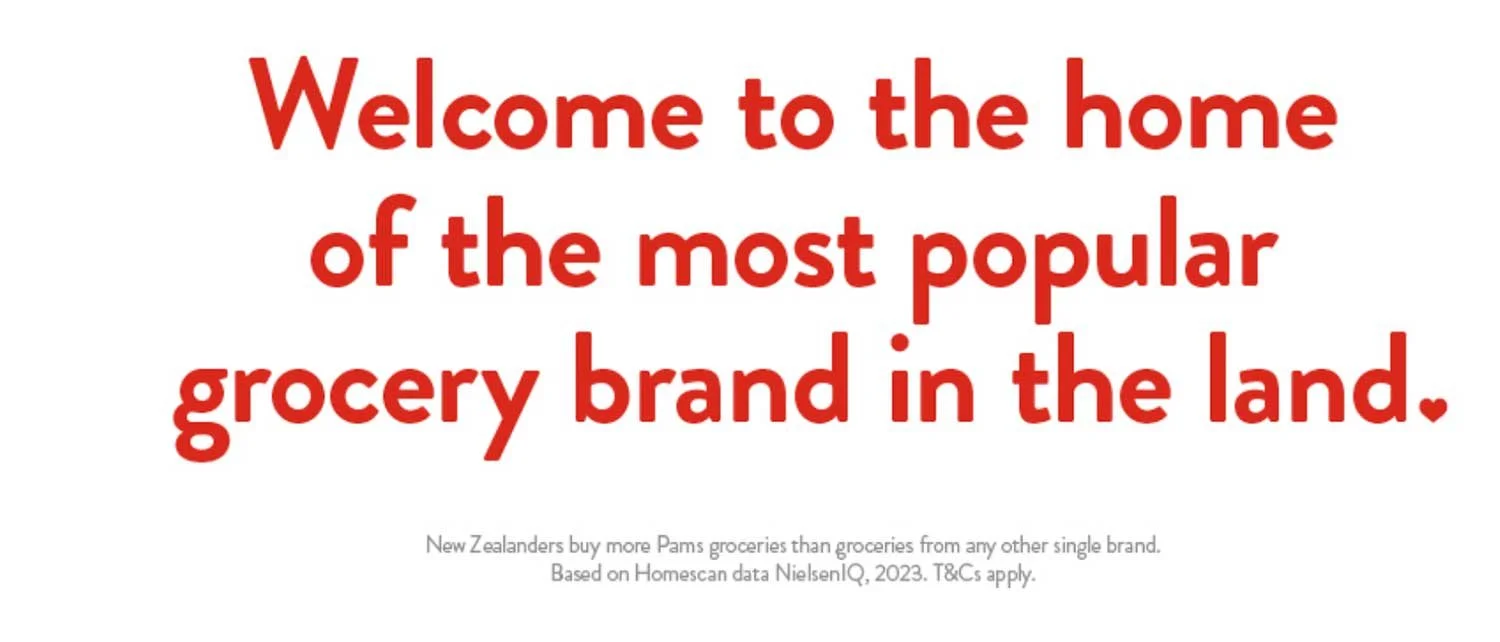
Pams has recently started an advertising and branding campaign claiming that it is “the most popular grocery brand in the land”. Their substantiation? “New Zealanders buy more Pams groceries than groceries from any other single brand. Based on Homescan data NielsonIQ, 2023. T&Cs apply.”
That’s directly from their website, and it’s a weasel claim. The “T&Cs apply” are proof of that.
Considering that Pams is the (often) cheapest white-label brand of choice for New World, Pak’nSave, and Four Square, their claim seems legitimate—or does it?
Pams is part of New Zealand’s grocery cartel, so it’s obvious that they’ll sell more since they have more shelf space, lower prices, and the widest range of products. This doesn’t make them the most popular brand.
The claim Pams puts out there is the same as the New Zealand Transport Agency claiming that the SH1 motorway is New Zealand’s most popular road because it sees the most traffic.
Bunnings and Mitre10 have their own nebulous claim, which also comes with T&Cs: if you find a lower-priced item at a competitor, they’ll beat that price by 15%.
But since they’re another cartel, they can control their stock, which means you’ll never find the exact same big-ticket products like a Masport lawnmower at Bunnings or find a Bosch lawnmower at Mitre 10.
Even if you drill down to products like turpentine or nails, the brands are never the same at the two stores, so how much worth is there in a perceived 15% discount?
It was David Ogilvy who stated that “the consumer is not a moron.” But every day, more and more advertisers and big businesses push us into that category. That’s not where I want anyone to be.
Shouldn’t we all be loath to be taken advantage of in this way? I know I am.
PS. I called Pams to find out what the T&Cs are, and they didn’t know themselves.